Mechanic Uniform Sourcing from China: Complete B2B Supply Guide
When procurement professionals look into buying clothes online in China for industrial workwear, the mechanic uniform category stands out as one of the most standardized and high-volume segments in the B2B space. China's workwear manufacturing ecosystem has matured over the past two decades, with production clusters in Guangdong, Henan, and Jiangsu provinces offering distinct advantages depending on order size, quality requirements, and delivery timelines.
China clothing manufacturers have developed specialized capabilities for mechanic uniforms that go beyond basic garment production. These facilities integrate fabric weaving, cutting, sewing, and finishing under one roof, which translates to better quality control and shorter lead times compared to fragmented supply chains in other sourcing destinations. For buyers considering buying clothes in bulk from China, the mechanic uniform sector offers particularly favorable economics through standardized sizing, repeatable production processes, and high-volume raw material purchasing power.
Product Overview: Mechanic Uniform Specifications
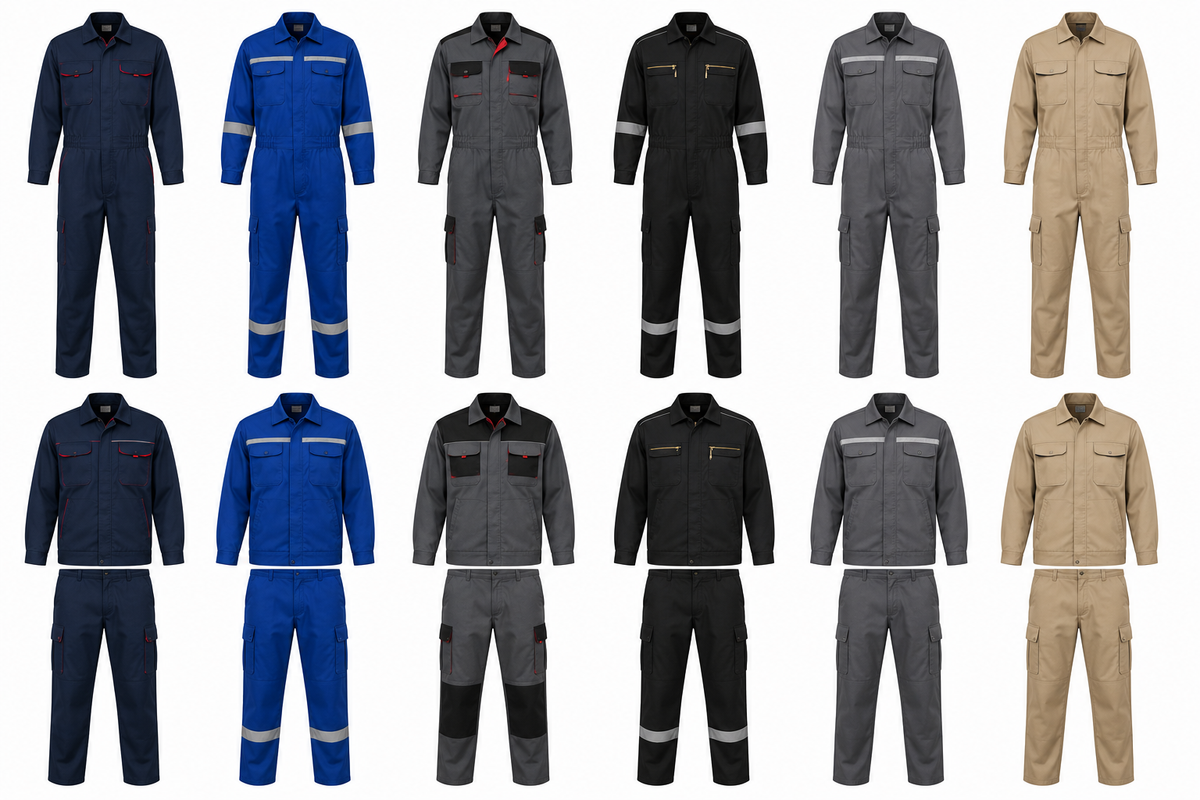
Mechanic uniforms fall within the broader industrial workwear segment, but they have specific requirements that distinguish them from general-purpose work clothes. A proper mechanic uniform must withstand exposure to grease, oil, and solvents while remaining comfortable during long shifts in workshop environments.
| Specification | Detail |
|---|---|
| Product Type | Coveralls, two-piece sets (jacket + trousers), shirt + pant combinations |
| Primary Use | Automotive repair, machinery maintenance, industrial workshops |
| Key Features | Oil-resistant, durable stitching, multiple tool pockets, reinforced knees |
| Sizing Range | XS to 5XL (Asian and Western sizing available) |
| Color Options | Navy blue, charcoal grey, black, khaki, custom colors available |
The most common mechanic uniform configurations include coveralls, two-piece sets with jacket and trousers, and shirt-and-pant combinations. Each style serves different workplace needs. Coveralls offer full-body protection and are preferred in heavy machinery maintenance settings. Two-piece sets provide more flexibility and are common in automotive service centers where technicians move between workstations frequently.
Material Specifications and Fabric Options
When buyers approach China wholesale clothing suppliers for mechanic uniforms, the conversation typically starts with fabric specifications. Polyester-cotton blends dominate this category, with ratios depending on durability and breathability requirements.
| Fabric Type | Composition | Weight (GSM) | Key Properties | Best Application |
|---|---|---|---|---|
| Standard Twill | 65% Polyester / 35% Cotton | 220-240 | Durable, wrinkle-resistant, breathable | General workshop use |
| Heavy Duty Twill | 80% Polyester / 20% Cotton | 260-280 | High abrasion resistance, oil-repellent | Heavy machinery maintenance |
| Cotton Rich | 50% Polyester / 50% Cotton | 200-220 | Superior breathability, soft feel | Warm climate workshops |
| Rip-Stop | 65% Polyester / 35% Cotton | 220-240 | Tear-resistant, lightweight | High-risk environments |
| Stretch Blend | 60% Polyester / 35% Cotton / 5% Spandex | 210-230 | Mobility, comfort | Service centers, auto repair |
Pure cotton options exist but are less common for heavy-duty applications due to shrinkage concerns and lower abrasion resistance. For buyers who have visited the China clothes wholesale market in Guangzhou or other production hubs, the range of available fabrics extends to specialized materials. Flame-resistant fabrics using Nomex or similar fibers are available but command premium pricing and are typically required for welding or high-heat applications.
| Specialized Treatment | Purpose | Applicable Fabrics |
|---|---|---|
| Oil-Repellent Coating | Repels grease and solvents | Twill, Rip-Stop |
| Anti-Static Treatment | Prevents electrostatic discharge | Cotton rich, Twill |
| Flame Retardant | Meets EN ISO 11611/11612 standards | 100% Cotton, FR-treated blends |
| Water-Repellent | Resists light moisture and spills | Twill, Rip-Stop |
| Wrinkle-Resistant | Maintains professional appearance | Polyester-rich blends |
Minimum Order Quantities (MOQ)
MOQ is often the first question B2B buyers ask when exploring China clothes wholesale options for mechanic uniforms. The answer varies significantly depending on the supplier's position in the market.
| Supplier Tier | MOQ per Style/Color | Unit Price Impact | Best For |
|---|---|---|---|
| Large-Scale Manufacturers | 500 - 1,000 pieces | Lowest pricing | Established brands, large retailers |
| Mid-Tier Manufacturers | 100 - 300 pieces | Moderate pricing | Growing brands, multi-SKU buyers |
| Small Batch Specialists | 50 - 100 pieces | Higher per-unit cost | Testing new markets |
| Sample Orders | 2 - 10 pieces | Premium rate | Product evaluation, fit testing |
Large-scale manufacturers with production lines optimized for high-volume runs typically set MOQs at 500 to 1,000 pieces per style and color combination. These factories offer the most competitive unit pricing but require substantial inventory commitment.
Mid-tier clothing manufacturers in China, particularly those in Henan province where labor costs are lower, often accept MOQs of 100 to 300 pieces per design. This range suits buyers who are testing new markets or managing multiple SKUs with moderate quantities.
For buyers with limited initial orders, several China vendors for clothing now offer MOQs as low as 2 to 10 pieces for sample runs. While this is not viable for commercial production, it allows buyers to evaluate quality and fit before committing to larger quantities. The trend toward lower entry barriers reflects growing competition among China wholesale clothing suppliers who recognize that international buyers increasingly prefer to test before scaling.
Production Lead Time
Lead time is a critical factor in the sourcing decision. When buyers look into buying clothes online in China for mechanic uniforms, they need clear expectations about production schedules to manage their inventory planning effectively.
| Order Size | Sample Development | Sample to Bulk Transition | Total Production Time |
|---|---|---|---|
| Under 500 pieces | 7 - 10 days | 3 - 5 days | 15 - 20 working days |
| 500 - 2,000 pieces | 7 - 10 days | 5 - 7 days | 20 - 30 working days |
| 2,000 - 5,000 pieces | 10 - 12 days | 7 - 10 days | 30 - 40 working days |
| 5,000+ pieces | 10 - 12 days | 10 - 14 days | 40 - 50 working days |
| Sample Only | 5 - 7 days | N/A | 7 - 10 days |
Sample development typically takes 7 to 10 days from design approval. This includes pattern making, cutting, sewing, and finishing of the sample pieces. For custom designs with complex features like multiple pockets, reflective tape, or custom embroidery, the sample phase may extend to 14 days. Some suppliers offer expedited sample service at additional cost.
Production lead time for bulk orders varies by order size and factory capacity. For orders under 500 pieces, 15 to 20 working days is standard across most China manufacturers clothing facilities. Orders between 500 and 2,000 pieces typically require 20 to 30 days. Large orders exceeding 5,000 pieces may extend to 40 days or more, though many factories have established production lines that can accelerate large-volume runs.
| Lead Time Factor | Impact on Schedule |
|---|---|
| Custom Fabric Production | Adds 10 - 15 days |
| Custom Embroidery/Printing | Adds 3 - 5 days |
| Special Packaging | Adds 3 - 7 days |
| Chinese New Year Period | Adds 2 - 3 weeks |
| Peak Season (Aug - Oct) | Adds 5 - 10 days |
| Factory Capacity | Variable, check with supplier |
Seasonal factors affect lead times as well. The Chinese New Year period typically adds two to three weeks to production schedules as factories shut down for the holiday. Buyers should plan orders to avoid this peak disruption period, typically January through February.
Quality Assurance and Inspection Protocol
Quality assurance is where professional sourcing agents and experienced buyers differentiate themselves from newcomers. The most reliable China clothing manufacturers implement multi-stage inspection processes that catch defects before they reach shipping containers.
| Inspection Stage | Timing | Key Check Points | Acceptance Criteria |
|---|---|---|---|
| Fabric Inspection | Pre-production | Color, weight, defects | AATCC / ISO standards |
| In-Line Inspection | During sewing | Stitch density, alignment | ±1 cm tolerance |
| Pre-Final Inspection | Before finishing | Measurements, hardware | Critical defects: 0% |
| Final Random Inspection | Before shipment | Overall quality, packaging | AQL 1.5 / 2.5 |
| Container Loading | During packing | Quantity, carton condition | 100% count verification |
In-line inspections occur at critical production stages, typically during cutting, sewing, and finishing. Factory quality control teams check fabric quality, stitch consistency, and measurement accuracy against approved samples. The best suppliers maintain defect rates below 2% for standard mechanic uniform orders, though this can vary depending on the complexity of the design.
Final inspections before shipment verify that finished products match sample standards in color, size, and construction. Buyers can hire third-party inspection services or rely on factory-based quality teams if the supplier has established credibility. Many China wholesale clothing suppliers now offer video inspections or live camera access to production floors as part of their service package.
| Common Quality Issues | Detection Method | Prevention Measure |
|---|---|---|
| Uneven stitching | Visual inspection, stitch count | Regular machine calibration |
| Color variation (batch-to-batch) | Spectrophotometer testing | Same dye lot, controlled process |
| Inaccurate sizing | Measurement check | Standardized grade rules |
| Zipper malfunction | Pull test | Quality hardware selection |
| Fading after wash | Wash test | Pre-treated fabrics |
| Loose buttons / hardware | Pull test | Reinforced attachment |
Common quality issues in mechanic uniforms include uneven stitching, color variation between production batches, and inaccurate sizing. Reputable clothing manufacturers in China have developed systems to minimize these problems. For the mechanic uniform category, key quality metrics include seam strength, zipper reliability, and pocket reinforcement durability.
Certifications and Compliance Standards
International buyers increasingly require certification verification when sourcing mechanic uniforms from China. Clothing manufacturers in China can provide several standard certifications depending on the target market.
| Certification | Standard | Requirement | Target Market |
|---|---|---|---|
| Oeko-Tex Standard 100 | Chemical safety | No harmful substances | Europe, Global |
| ISO 9001 | Quality management system | Documented processes | Global |
| ISO 14001 | Environmental management | Sustainable production | Europe, North America |
| EN ISO 11611 | Flame resistance (welding) | Protective for welders | Europe |
| EN ISO 11612 | Flame resistance (general) | Heat/flame protection | Europe |
| ANSI/ISEA 107 | High visibility | Reflective materials | North America |
| OEKO-TEX Made in Green | Sustainable textile | Eco-friendly production | Europe |
| BSCI | Social compliance | Ethical manufacturing | Europe, Global |
Oeko-Tex Standard 100 certification addresses chemical safety in textiles. This is particularly important for uniforms that come into direct contact with skin for extended periods. The certification ensures that no harmful substances are present in the finished product. Many European buyers require this as a baseline standard.
ISO 9001 certification indicates that the manufacturer operates a quality management system. While this does not guarantee product quality, it suggests consistent processes and documented quality controls. For buyers evaluating China vendors for clothing at scale, ISO 9001 is a useful screening criterion.
Industry-specific certifications apply to certain mechanic uniform applications. EN ISO 11611 and 11612 cover flame resistance for welding applications. ANSI/ISEA 107 addresses high-visibility requirements for workwear used in roadside or construction settings. Not all mechanic uniforms need these certifications, but buyers with specific workplace safety requirements should confirm that suppliers can provide the appropriate documentation.
Packaging Options
Packaging for mechanic uniforms serves both protective and retail functions, and suppliers typically offer multiple options. China clothing manufacturers provide standard export packaging as their base offering.
| Packaging Type | Description | MOQ | Unit Cost Impact | Best For |
|---|---|---|---|---|
| Standard Export | Poly bag + master carton, 15-20 sets per carton | 100 pieces | Base price | Wholesale, warehouse storage |
| Custom Poly Bag | Printed poly bag with branding | 500 pieces | + $0.30 - 0.50 / piece | Retail distribution |
| Hanger Pack | Garments on hangers, poly bagged | 300 pieces | + $0.80 - 1.20 / piece | Retail display, direct-to-store |
| Carton Box | Individual garment box with branding | 500 pieces | + $2.00 - 3.50 / piece | Premium retail, corporate uniform kits |
| Bulk Pack | No individual poly bag, carton only | 500 pieces | Base - 10% | Cost-saving, internal use |
Individual poly bags for each garment, packed into master cartons of 15 to 20 sets depending on garment thickness and volume. Carton dimensions typically range around 40 by 35 by 30 centimeters, optimized for container loading.
| Carton Specification | Standard Size (cm) | Size (inches) | Approx. Weight |
|---|---|---|---|
| Coveralls (lightweight) | 45 x 35 x 30 | 17.7 x 13.8 x 11.8 | 10 - 12 kg |
| Coveralls (heavy weight) | 45 x 38 x 32 | 17.7 x 15.0 x 12.6 | 14 - 16 kg |
| Two-Piece Set | 50 x 40 x 35 | 19.7 x 15.7 x 13.8 | 12 - 15 kg |
| Shirt + Pant | 48 x 38 x 32 | 18.9 x 15.0 x 12.6 | 10 - 13 kg |
| Trousers Only | 42 x 32 x 28 | 16.5 x 12.6 x 11.0 | 8 - 10 kg |
Retail packaging options are available for buyers who want to sell directly to consumers or provide uniform kits to employees. These include custom-printed poly bags, hanger packs, or even garment boxes with branding. The MOQ for retail packaging is typically higher than for standard export packaging, often starting at 500 pieces.
Some buyers choose to have uniforms shipped on hangers, which reduces wrinkling but increases shipping volume. This option adds to freight costs but may be worthwhile for premium positioning or if garments will move directly from warehouse to employee distribution.
Shipping Timelines and Logistics
Ship time from China to destination markets varies by shipping method and port location. Most mechanic uniform orders move by ocean freight unless quantities are small enough for air transport.
| Shipping Method | Transit Time | Cost Indicator | Best For |
|---|---|---|---|
| Ocean Freight - FCL | 18 - 22 days (West Coast) | $ | Large orders, bulk purchasing |
| Ocean Freight - FCL | 25 - 30 days (East Coast) | $$ | Large orders, US East |
| Ocean Freight - FCL | 25 - 30 days (Europe) | $$ | European orders |
| Ocean Freight - LCL | 25 - 30 days | $$$ | Smaller orders, consolidation |
| Air Freight | 5 - 8 days | $$$$$ | Urgent orders, samples |
| Express (DHL/UPS/FedEx) | 3 - 5 days | $$$$$$ | Samples, small packages |
Sea freight from main Chinese ports to the US West Coast typically takes 18 to 22 days. East Coast destinations add another 7 to 10 days through the Panama Canal. European ports in Rotterdam or Hamburg generally receive shipments in 25 to 30 days. Middle Eastern destinations like Dubai or Jeddah require 18 to 24 days by sea.
| Port of Origin | Destination | Sea Freight Days | Air Freight Days |
|---|---|---|---|
| Shanghai | Los Angeles | 18 - 20 | 5 - 6 |
| Ningbo | Long Beach | 19 - 22 | 5 - 6 |
| Guangzhou | Rotterdam | 28 - 30 | 6 - 8 |
| Shenzhen | Hamburg | 26 - 28 | 6 - 7 |
| Shanghai | Dubai | 18 - 20 | 5 - 6 |
| Ningbo | Jeddah | 20 - 24 | 5 - 7 |
| Guangzhou | Sydney | 16 - 18 | 6 - 8 |
Air freight is faster at 5 to 8 days but significantly more expensive. For urgent orders or samples, air freight may be justified. Some buyers use air freight for initial stock and then switch to sea freight for replenishment orders.
Consolidation services combine orders from multiple suppliers into one shipment, reducing per-unit shipping costs. This is particularly valuable for buyers sourcing multiple product categories or working with different China clothing manufacturers. The consolidation point is typically near the port, in Guangzhou, Shanghai, or Ningbo depending on the factory locations.
Pricing Structure and Cost Components
Understanding the pricing structure helps buyers evaluate offers from different China wholesale clothing suppliers and identify cost-saving opportunities.
| Cost Component | Typical Range | Factors Influencing Cost |
|---|---|---|
| Fabric Cost | 35 - 45% of FOB price | Quality, blend ratio, quantity |
| Labor Cost | 20 - 30% of FOB price | Design complexity, factory location |
| Trims & Accessories | 5 - 10% of FOB price | Zippers, buttons, reflective tape |
| Overhead & Profit | 10 - 15% of FOB price | Factory efficiency, scale |
| Packaging | 3 - 7% of FOB price | Type, branding requirement |
| Inspection Fee | $200 - 500 per inspection | Third-party service, order size |
| FOB Price Range | $8 - 25 per piece | Fabric, quantity, features |
The FOB price for mechanic uniforms from China typically ranges from $8 to $25 per piece depending on fabric quality, design complexity, and order quantity. Standard polyester-cotton coveralls at 500-piece quantities generally fall in the $10 to $14 range. Two-piece sets with multiple pockets and reinforced features typically price between $15 and $20. Premium options with stretch fabric, custom embroidery, or retail packaging can reach $22 to $28.
| Additional Service | Fee Structure | Typical Cost |
|---|---|---|
| Sample Making | Fixed per design | $80 - 150 per sample |
| Sample Shipping | Per shipment | $30 - 80 (express) |
| Pattern Adjustment | Per design | $50 - 100 |
| Embroidery Setup | Per design | $50 - 200 one-time |
| Custom Label | Per piece | $0.10 - 0.50 |
| Third-Party Inspection | Per day | $250 - 400 |
Why Source Mechanic Uniforms from China
The mechanic uniform supply chain from China offers compelling advantages for international buyers across multiple categories. China clothing manufacturers have built extensive production capacity, with dedicated workwear factories that can handle anything from small sample batches to container-sized bulk orders.
Production scale and capacity are the most obvious advantages. China clothing factories operate at scales that few other manufacturing destinations can match. A single factory in Guangdong province might produce 50,000 mechanic uniforms monthly, with the ability to scale up for seasonal demand spikes. This capacity translates to shorter lead times for large orders and the flexibility to accommodate rush requests when needed.
Supply chain integration reduces costs and improves reliability. Many China clothing manufacturers source fabric directly from domestic mills, manage their own dyeing and finishing, and maintain in-house embroidery and printing capabilities. This vertical integration eliminates multiple layers of markup and reduces coordination risk compared to fragmented supply chains.
Technical expertise is another significant advantage of clothing manufacturers overseas, particularly in the workwear category. Chinese factories have accumulated years of experience producing for international brands and military contracts, giving them technical understanding of material specifications, sizing standards, and quality requirements across multiple markets.
Cost competitiveness remains important, but it is no longer the only factor. China's advantage now extends to speed, reliability, and the ability to handle complex orders with multiple style variations. For buyers who need consistent quality across large volumes, China manufacturers clothing facilities offer proven capability.
| Advantage | Benefit to Buyer |
|---|---|
| Production Scale | 50,000+ pieces per month capacity |
| Vertical Integration | Single supplier for fabric + production + finishing |
| Technical Experience | Expertise in workwear specifications |
| Flexible MOQ | Options from samples to container loads |
| Logistics Network | Multiple ports with established shipping routes |
| Quality Infrastructure | In-house and third-party inspection options |
Making the Right Sourcing Decision
The mechanic uniform supply chain from China has become sophisticated and accessible, but success depends on asking the right questions and building relationships with reliable suppliers. Buyers who take the time to understand material specifications, quality standards, and production timelines will find China clothing manufacturers to be competitive partners in their sourcing strategy.
The combination of production scale, technical expertise, and logistics infrastructure makes China a natural choice for mechanic uniform procurement. For procurement professionals evaluating whether to source mechanic uniforms from China, starting with clear specifications, reasonable order quantities, and realistic lead time expectations will set the foundation for a successful partnership.
The market offers options across every price and quality tier, making it possible to find the right fit for almost any business requirement. Working with suppliers who have established export experience reduces the learning curve significantly, and investing in quality verification processes pays dividends in consistent product outcomes.
Whether you are buying clothes online in China for the first time or expanding existing supply relationships, the mechanic uniform category offers a proven track record of reliable production, competitive pricing, and professional service from experienced manufacturing partners.