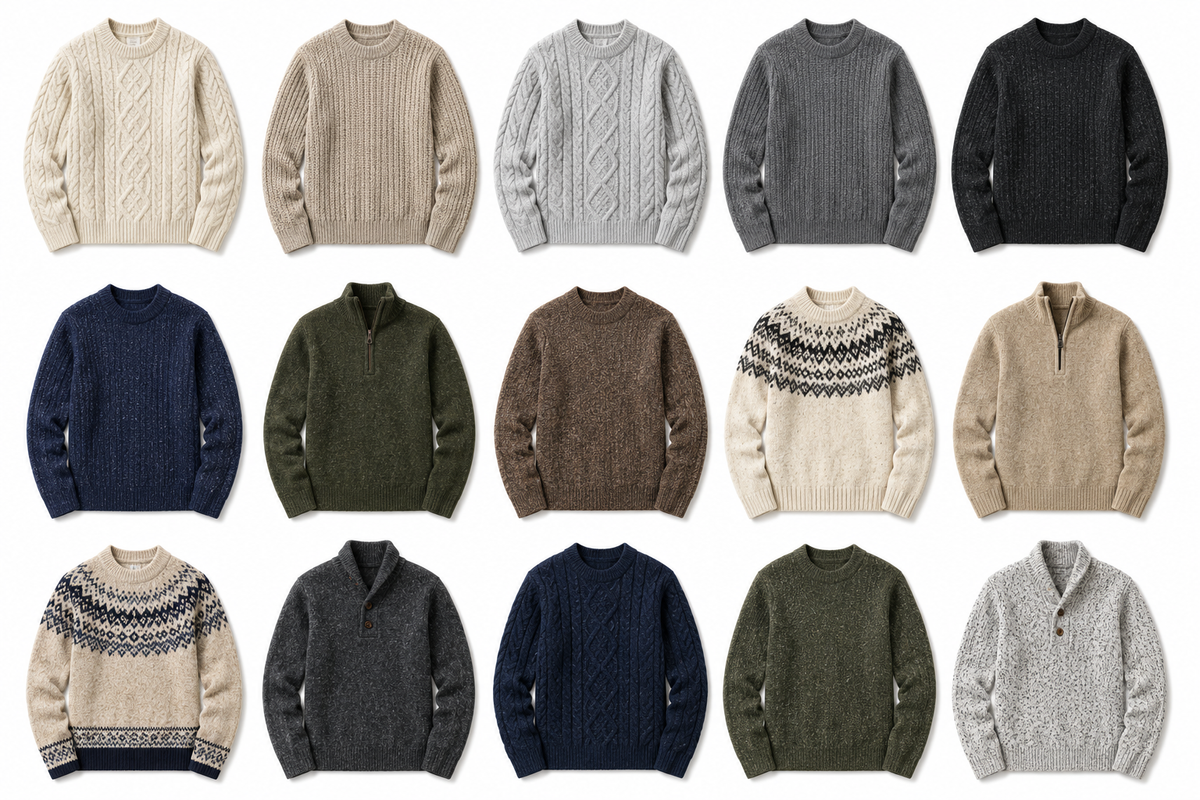
Wool Sweater Sourcing from China: Complete B2B Supply Guide
For buyers exploring Chinese clothing manufacturers for wool sweaters, understanding the production landscape is essential. China has become a dominant force in wool knitwear manufacturing, with key production clusters in Zhejiang, Guangdong, and Anhui provinces offering distinct advantages for different order types and quality tiers. The Guangzhou Clothes Market remains a significant hub for buyers seeking direct access to manufacturers, while online platforms have expanded access to suppliers across the country.
The wool sweater category sits alongside cashmere in the premium knitwear segment, but wool offers distinct advantages in terms of durability, moisture management, and price accessibility. Clothing suppliers China have developed extensive capabilities in merino wool processing, blend development, and garment construction, making them reliable partners for brands at various market positions.
For buyers looking to identify the best clothing manufacturers in China for wool sweaters, the following guide provides comprehensive information on specifications, production processes, and quality considerations.
Product Overview: Wool Sweater Categories
Wool sweaters span a wide range of styles, yarn qualities, and construction methods. Clothing makers China typically organize their wool sweater production around these core product categories.
| Product Category | Typical Styles | Key Features | Target Market |
|---|---|---|---|
| Pure Wool Sweaters | Crew-neck, V-neck, turtleneck, cardigan | 100% wool, warmth retention, breathability | Mid-to-premium retail |
| Merino Wool Sweaters | Lightweight, fine-gauge knits | Ultra-fine fiber (17.5-19.5 microns), soft handle | Premium and outdoor brands |
| Wool Blend Sweaters | Various with blend compositions | Wool with acrylic, nylon, or cotton for durability | Mass-market, promotional |
| Wool-Cashmere Blends | Luxe knits with mixed fibers | Added warmth and softness from cashmere content | High-end collections |
| Chunky Wool Knits | Heavyweight winter sweaters | Textured finishes, cold weather focus | Winter collections |
| Design Feature | Standard Configuration | Premium Configuration |
|---|---|---|
| Neck Style | Crew-neck, V-neck | Custom neck designs, convertible collars |
| Sleeve | Set-in, raglan | Custom sleeve designs |
| Knit Gauge | 7GG, 12GG | 3GG to 18GG options |
| Knit Pattern | Plain knit, ribbed | Jacquard, cable, intarsia |
| Hardware | Buttons, zipper | Custom hardware options |
Designer clothes suppliers China often offer extensive customisation options, allowing brands to develop unique styles and construction details that differentiate their collections.
Material Specifications
When sourcing through clothing suppliers China, understanding wool specifications is crucial. The quality of wool fiber directly determines garment performance, durability, and consumer satisfaction.
| Specification | Standard Grade | Premium Grade | Luxury Grade |
|---|---|---|---|
| Fiber Origin | Australia (broad) / China | Australia (select) / New Zealand | Australian Merino, New Zealand |
| Mean Fiber Diameter | 22.5 - 24.5 microns | 19.5 - 22.5 microns | 17.5 - 19.5 microns |
| Yarn Construction | 2-ply | 2-ply or 3-ply | 2-ply or higher |
| Color Fastness | Standard | Good | Excellent |
| Pilling Resistance | Standard (Grade 2-3) | Enhanced (Grade 3-4) | Premium (Grade 4+) |
| Shrinkage Control | Standard | Good | Excellent |
| Fabric Type | Composition | Weight (GSM) | Key Properties | Best Application |
|---|---|---|---|---|
| 100% Wool | 100% Merino wool | 180-260 | Natural warmth, moisture wicking, breathable | Premium collections |
| Merino Wool | 100% Merino (fine) | 160-220 | Ultra-soft, temperature regulating | Outdoor, performance wear |
| Wool-Blend | 30-50% Wool / acrylic | 200-280 | Affordable warmth, easier care | Mass market |
| Wool-Nylon Blend | 70-90% Wool / nylon | 200-260 | Improved durability, shape retention | Hard-wearing applications |
| Wool-Cashmere Blend | 5-30% Cashmere / wool | 190-240 | Enhanced softness, luxury feel | Premium brand programs |
| Specialized Treatment | Purpose | Applicable Fabrics |
|---|---|---|
| Anti-Pilling Treatment | Reduces fiber shedding | All wool fabrics |
| Permanent Press | Wrinkle resistance | Blends |
| Colorfast Dyeing | Long-lasting color | All wool fabrics |
| Shrinkage Control | Minimises washing shrinkage | All wool fabrics |
| Superwash Treatment | Machine-washable wool | Merino, standard wool |
According to Chinese textile standards, products marketed as "纯羊毛" (pure wool) must contain 100% wool fiber. The designation "纯新羊毛" (pure new wool) further requires the use of virgin wool without recycled fiber content . Many Chinese clothing manufacturers now offer Oeko-Tex Standard 100 certified wool sweaters, providing chemical safety verification for international markets.
Minimum Order Quantities
MOQ for wool sweaters varies based on yarn availability, customisation level, and supplier type. Designer vendors in China and boutique manufacturers often offer more flexible terms.
| Supplier Type | MOQ per Style/Color | Unit Price Impact | Best For |
|---|---|---|---|
| Large Factories | 500 - 1,000 pieces | Lowest pricing | Large retail chains, volume programs |
| Mid-Size Factories | 100 - 300 pieces | Moderate pricing | Growing brands, seasonal lines |
| Flexible Suppliers | 50 - 100 pieces | Moderate pricing | Test orders, boutique brands |
| Small Batch Specialists | 20 - 50 pieces | Higher per-unit cost | Limited editions, sampling |
| Sample Orders | 1 - 10 pieces | Premium rate | Quality evaluation, fit testing |
The clothing manufacturers in China Alibaba platform typically show MOQs between 100 and 500 pieces for custom production, with stock order options available at lower quantities . According to industry pricing data, MOQ significantly affects unit economics: a 50-piece order might cost approximately $11 per piece, while a 1,000-piece order could drop to around $7.50 per piece for comparable specifications. This represents a saving of roughly 32% at higher volumes .
For buyers exploring Designer Clothes Suppliers China with custom design requirements, MOQs are typically higher due to the setup costs involved in pattern development and knitting machine programming.
Production Lead Times
Wool sweater production requires careful scheduling due to the yarn processing, knitting, and finishing steps involved. Clothing factory in China operations typically follow these timelines.
| Order Volume | Sample Development | Bulk Production | Total Lead Time |
|---|---|---|---|
| Under 100 pieces | 5 - 7 days | 10 - 14 days | 15 - 21 working days |
| 100 - 500 pieces | 7 - 12 days | 14 - 21 days | 21 - 33 working days |
| 500 - 2,000 pieces | 10 - 15 days | 21 - 30 days | 31 - 45 working days |
| 2,000 - 5,000 pieces | 12 - 18 days | 30 - 40 days | 42 - 58 working days |
| 5,000+ pieces | 14 - 21 days | 40 - 55 days | 54 - 76 working days |
| Sample Only | 5 - 10 days | N/A | 5 - 10 days |
| Lead Time Factor | Impact on Schedule |
|---|---|
| Custom Yarn Development | Adds 10 - 14 days |
| Custom Dyeing | Adds 7 - 14 days |
| Complex Knit Patterns | Adds 5 - 10 days |
| Custom Labeling/Embroidery | Adds 3 - 5 days |
| Chinese New Year Period | Adds 2 - 3 weeks |
| Peak Season (Aug - Oct) | Adds 5 - 10 days |
A major wool sweater manufacturer reports typical lead times of 7 to 30 days after order confirmation, depending on product specifications . For stock items, ready-to-ship wool sweaters can be dispatched within 1 working day, while custom production typically requires 14 to 21 days for orders of around 400 to 500 pieces . Another supplier indicates sample production can be completed in 5 to 7 working days, with bulk orders finalised within 15 to 30 days after sample approval .
Quality Assurance
Quality assurance for wool sweaters requires attention to fiber quality, knitting consistency, finishing, and garment integrity. The best clothing manufacturers in China implement comprehensive quality systems.
| Inspection Stage | Timing | Key Check Points | Acceptance Criteria |
|---|---|---|---|
| Yarn Quality Inspection | Pre-production | Fiber fineness, twist, color consistency | Meets specification |
| Knitting Tension Check | During knitting | Stitch uniformity, gauge accuracy | Consistent throughout |
| In-Line Production Check | During knitting | Pattern alignment, defect detection | Zero structural defects |
| Finishing Inspection | After washing | Shrinkage, pilling (Grade 3-4), hand feel | Meets sample standard |
| Pre-Final Inspection | 80% production complete | Measurements, construction, colour | Critical defects: 0% |
| Final Random Inspection | Before shipment | Overall quality, packaging | AQL 1.5 / 2.5 |
| Common Quality Issues | Detection Method | Prevention Measure |
|---|---|---|
| Pilling after wear | Abrasion testing | Quality fiber selection, anti-pilling treatment |
| Color variation between batches | Spectrophotometer testing | Same dye lot control |
| Shrinkage after wash | Wash testing | Pre-treated yarn, Superwash treatment |
| Uneven tension | Visual inspection | Machine calibration |
| Inconsistent sizing | Measurement check | Standardised grade rules |
Chinese clothing manufacturers exporting to regulated markets maintain quality systems that meet international expectations. The T/CNTAC 138—2023 standard, published by the China National Textile and Apparel Council, provides a quality grading framework specifically for wool sweaters with at least 30% wool content . This standard supports quality evaluation and classification for sourcing decisions.
Certifications and Compliance
Wool sweater buyers must verify that clothing suppliers China can meet the certification requirements for their target markets. The certification landscape varies depending on product content, destination, and consumer positioning.
| Certification | Standard | Requirement | Target Market |
|---|---|---|---|
| Oeko-Tex Standard 100 | Chemical safety | No harmful substances in textiles | Europe, Global |
| REACH Compliance | Chemical regulation | SVHC restrictions | Europe |
| GRS (Global Recycled Standard) | Recycled content | Traceability of recycled materials | Europe, North America |
| ISO 9001 | Quality management | Documented processes | Global |
| ISO 14001 | Environmental management | Sustainable production | Europe, North America |
| Woolmark | Fiber quality assurance | 100% pure new wool | Global |
| BSCI | Social compliance | Ethical manufacturing | Europe, Global |
The Woolmark certification is particularly relevant for premium wool sweater sourcing. Woolmark certifies that garments contain 100% pure new wool, excluding recycled fibers . The certification process involves raw material verification, sample testing, and quality inspections. With over 600 Woolmark licensees worldwide, including 166 in China, this certification is accessible for buyers seeking assurance on wool quality .
For wool blend products, the wool content standard provides a baseline classification. Products with 30% or higher wool content meet the basic standard for "wool sweater" classification, while the emerging "优品毛衫" standard requires wool content of 60% or higher for premium positioning .
Packaging Options
Wool sweater packaging must protect delicate garments while enabling efficient distribution. Clothing suppliers China typically offer multiple options based on buyer requirements.
| Packaging Type | Description | MOQ | Unit Cost Impact | Best For |
|---|---|---|---|---|
| Standard Export | Poly bag + master carton, 15-25 pieces per carton | 50 pieces | Base price | Wholesale distribution |
| Premium Individual Bag | Higher quality garment bag | 100 pieces | + $0.40 - 0.80 / piece | Mid-range retail |
| Hanger Pack | Garments on hangers, poly bagged | 200 pieces | + $0.80 - 1.20 / piece | Direct-to-store, seasonal programs |
| Custom Printed Bag | Branded poly bag with logo | 300 pieces | + $0.50 - 1.00 / piece | Branded programs |
| Eco-Friendly Packaging | Recyclable materials, minimal plastic | 200 pieces | + $0.30 - 0.60 / piece | Sustainable brands |
| Garment Box | Premium box packaging | 500 pieces | + $2.00 - 4.00 / piece | Luxury retail |
| Roll Packing | Compact roll format | 200 pieces | + $0.20 - 0.40 / piece | Space-efficient shipping |
| Carton Specification | Carton Size (cm) | Approx. Weight |
|---|---|---|
| Lightweight Merino (fine gauge) | 45 x 35 x 30 | 7 - 9 kg |
| Standard Wool Sweaters | 50 x 40 x 35 | 12 - 15 kg |
| Chunky Wool Sweaters | 55 x 42 x 40 | 14 - 18 kg |
Some Chinese clothing factory operations offer roll packing or carton packing options, with packaging materials specified according to buyer requirements . Packaging costs are typically factored into the overall FOB pricing structure.
Shipping Timelines
Shipping timelines for wool sweaters vary by destination, shipping method, and port choice. Most wool sweater orders move by ocean freight due to the weight and volume of knitwear shipments.
| Shipping Method | Transit Time | Cost Indicator | Best For |
|---|---|---|---|
| Ocean Freight - FCL to US West Coast | 18 - 22 days | $$ | Large orders, bulk purchasing |
| Ocean Freight - FCL to US East Coast | 25 - 30 days | $$ | Large orders, US East |
| Ocean Freight - FCL to Europe (Rotterdam) | 25 - 28 days | $$ | European orders |
| Ocean Freight - FCL to Middle East | 18 - 22 days | $$ | Middle East buyers |
| Ocean Freight - LCL | 25 - 32 days | $$$ | Smaller orders, consolidation |
| Air Freight | 5 - 8 days | $$$$$ | Urgent orders, high-value goods |
| Express (DHL/UPS/FedEx) | 3 - 5 days | $$$$$$ | Samples, small packages |
| Port of Origin | Destination Port | Sea Freight Days | Air Freight Days |
|---|---|---|---|
| Shanghai | Los Angeles | 18 - 20 | 5 - 6 |
| Ningbo | Long Beach | 19 - 22 | 5 - 6 |
| Shanghai | Rotterdam | 25 - 28 | 6 - 8 |
| Ningbo | Hamburg | 26 - 28 | 6 - 7 |
| Guangzhou | Sydney | 16 - 18 | 6 - 8 |
Wool sweater sourcing from China typically uses FOB (Free on Board) or CIF (Cost, Insurance, Freight) terms. Consolidation services can combine orders from multiple suppliers, reducing per-unit shipping costs for buyers sourcing from different clothing factories in China.
Pricing Structure
Wool sweater pricing reflects raw material costs, yarn quality, gauge complexity, and order volume. Understanding the cost components helps buyers evaluate quotes from different clothing manufacturers in China.
| Cost Component | Typical Range | Factors Influencing Cost |
|---|---|---|
| Raw Material (Wool) | 35 - 45% of FOB price | Fiber quality (micron count), origin |
| Yarn Processing | 15 - 20% of FOB price | Ply, spinning technique, dyed vs. natural |
| Knitting & Labor | 20 - 25% of FOB price | Gauge, pattern complexity, factory location |
| Finishing Treatments | 5 - 10% of FOB price | Anti-pilling, shrinkage control |
| Trims & Packaging | 3 - 5% of FOB price | Labels, packaging type |
| Overhead & Profit | 8 - 12% of FOB price | Factory efficiency, scale |
| Product Type | FOB Price Range | Typical MOQ |
|---|---|---|
| Wool Blend Sweater (acrylic-wool) | $11 - 16 | 50 pieces |
| 100% Merino Wool Sweater (12GG) | $14 - 20 | 50 pieces |
| Premium Merino Wool (fine) | $18 - 28 | 100 pieces |
| Wool-Cashmere Blend | $20 - 35 | 100 pieces |
| Chunky Knit Wool Sweater | $16 - 25 | 100 pieces |
| Custom Branded Wool Sweater | $15 - 30 | 100 pieces |
For a typical acrylic-wool blend sweater at 50-piece MOQ, ex-factory pricing ranges from $11 to $16, with retail pricing targets of approximately $38 to $65 depending on brand positioning. Premium merino wool sweaters command higher wholesale prices of $14 to $20 and retail in the $55 to $95 band .
Why Source Wool Sweaters from China
China has become the premier destination for wool sweater sourcing, combining raw material access, manufacturing capability, and supply chain infrastructure that few competing countries can match.
Raw material access provides China with a fundamental advantage. The country's wool processing capacity, combined with proximity to Australian and New Zealand wool producers, enables efficient sourcing of high-quality fibers. For merino wool specifically, Chinese clothing manufacturers have established strong supply chains that provide consistent quality for premium product lines.
Diverse manufacturing capability allows buyers to find appropriate production partners for any market position. From 3-gauge chunky knits to 18-gauge fine-gauge fully-fashioned sweaters, the range of production capacity in China is unmatched by other wool sweater producing countries. This breadth allows buyers to source everything from mass-market basics to luxury designer collections.
OEM and ODM infrastructure makes China particularly attractive for brand programs. Most established clothing factory in China operations have experience with OEM and custom production, enabling brands to develop unique products with private labelling . The clothing manufacturers in China Alibaba platform has further democratised access to these capabilities, allowing buyers to connect with factories across the country.
Scale and efficiency allow Chinese garment factories to maintain competitive pricing. Annual production capacity figures illustrate the scale: some manufacturers produce over 1.5 million sweaters annually, with facilities covering significant floor area . These production volumes enable investment in specialised equipment that maintains quality at scale.
Export infrastructure provides reliable logistics. Major ports in Shanghai, Ningbo, and Guangzhou offer efficient shipping routes to key markets, with established freight forwarding services that simplify international shipping.
| Advantage | Benefit to Buyer |
|---|---|
| Raw Material Access | Competitive pricing, consistent quality |
| Production Range | 3GG to 18GG capabilities, all styles |
| OEM/ODM Support | Private label, custom designs |
| Scale Efficiency | Competitive pricing, volume capacity |
| Export Experience | Streamlined documentation, reliable shipping |
The Guangzhou clothes market and other wholesale hubs provide direct access to suppliers, while online platforms enable remote sourcing. The sector has matured to serve buyers across the apparel spectrum, from luxury brands to mass-market retailers. The combination of production capability, material knowledge, and supply chain efficiency continues to make China the practical choice for wool sweater sourcing worldwide.